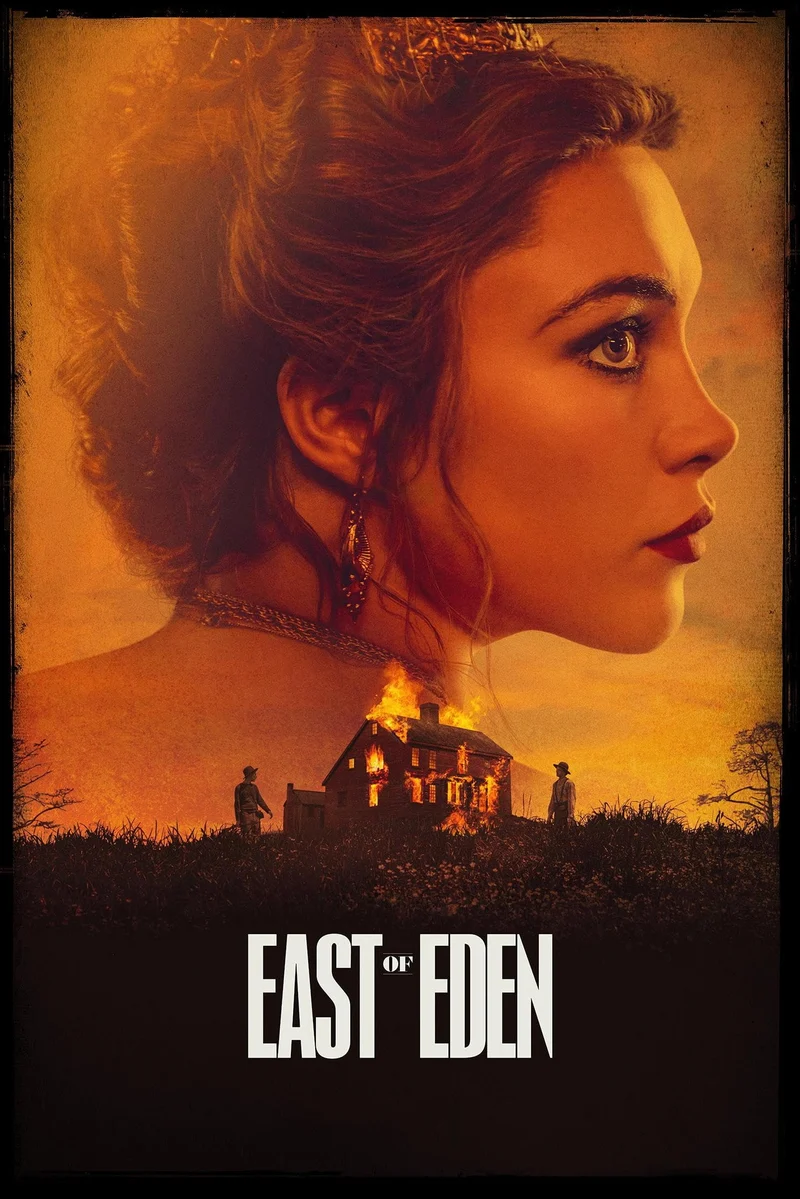
East of Eden brings John Steinbeck’s family saga into a new limited-series adaptation. Its central interest is inheritance in the broadest sense: money and land matter, but so do the stories a family repeats about goodness, rivalry and blame.
A new adaptation with its own perspective
Netflix identifies the seven-part series as an adaptation written by Zoe Kazan. Florence Pugh plays Cathy Ames, Christopher Abbott plays Adam Trask and Mike Faist plays Charles Trask. The story follows the Trask family across generations amid change in California. Hoon Lee plays Lee and Ciarán Hinds plays Samuel Hamilton. These names and the television format distinguish this project from an earlier same-titled film. It is an adaptation of the novel’s family world, rather than an automatic continuation of another screen version.
What does a family pass on?
A family saga can make repetition look like fate: one generation’s rivalry seems to reappear in another’s choices. The useful question is where the story leaves room for a person to act differently. Watch how a judgement made about someone early in life becomes an explanation for everything they later do. That pattern can shape both the person judged and the relatives doing the judging. A moral label may feel clear while obscuring the mixture of need, fear and agency behind a particular decision.
Why the serial form changes the emphasis
Multiple instalments allow relationships to develop alongside changes in the surrounding society. A useful adaptation discussion therefore asks whose experience receives time, rather than only whether a familiar scene appears. Readers can compare how the series translates the novel’s ideas into performance and shared spaces. Newcomers can follow the core family relationships before consulting a full genealogy. Keeping the question of choice in view prevents the saga from becoming a catalogue of unhappy inheritances: what matters is whether understanding a pattern gives anyone the freedom to interrupt it.