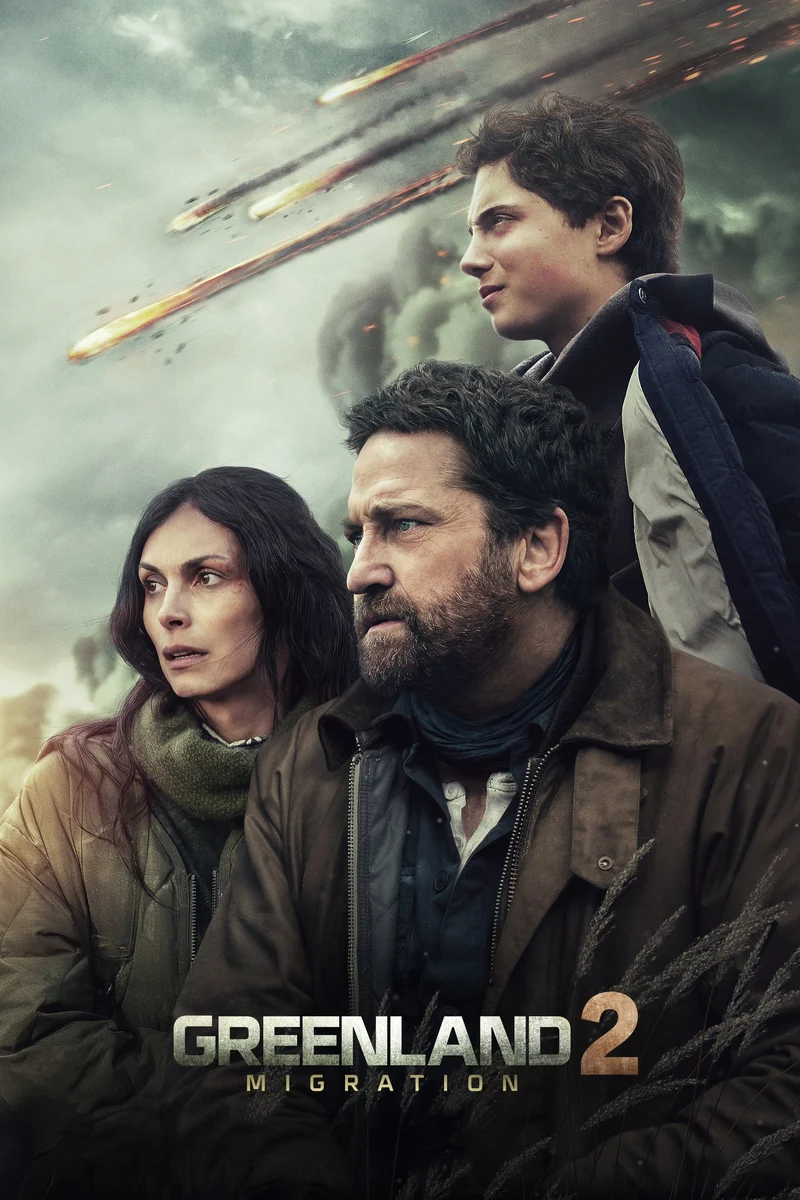
Greenland 2: Migration takes a disaster-survival family beyond the immediate refuge. The sequel’s premise asks a different question from reaching safety once: what does survival require when the place that protected you can no longer be your future?
The Garrity family is still the anchor
Lionsgate’s synopsis follows the Garrity family after a destructive comet strike. They must leave their Greenland bunker and search for a new home. Gerard Butler, Morena Baccarin and Roman Griffin Davis lead the cast, with Ric Roman Waugh directing and Mitchell LaFortune and Chris Sparling writing. These details identify the continuing family story and distinguish the sequel’s journey from the earlier race toward shelter. The premise supplies displacement and a search for somewhere to live, rather than a claim that the world simply returns to normal after the catastrophe.
An escape story becomes a migration story
Reaching a refuge can give a disaster film a clear destination. Leaving one removes that certainty and makes the journey about judging incomplete options. What counts as a promising place when old information may no longer describe it? Who gets to make a decision for a family when every route has costs? Those questions are useful ways to consider the sequel’s title. Migration involves more than movement across a map; it also involves deciding what can be carried, what must be left and which version of home remains possible.
Follow continuity through relationships
The first film provides the family’s earlier ordeal, so it is the clearest starting point for viewers interested in how that experience affects later choices. A newcomer can understand the official sequel premise, but a relationship’s accumulated strain is harder to recover from a short recap. For discussion, compare the responsibilities of an immediate rescue with those of finding a durable future. Keep fictional routes and survival decisions within the story’s disaster setting rather than treating them as practical emergency guidance. The meaningful stake is how the family continues living, not only whether another obstacle is crossed.