With 30 credits in the panel and 2 reserved for pending work, the planning balance is 28 free credits. At an entered usage rate of 0.5 credit per day, a fourteen-day buffer is 7 credits and the free balance represents 56 days at that rate. These are estimates from the entered numbers, not a demand forecast.
Reserve pending work once
The panel may still display 30 credits while a separate work list includes 2 credits of agreed but unfinished allocations. Subtract the reserved amount to see what is free for other planning: 30 − 2 = 28. Do not also subtract those same pending rows as completed usage until the records have been reconciled.
Use a stated daily rate
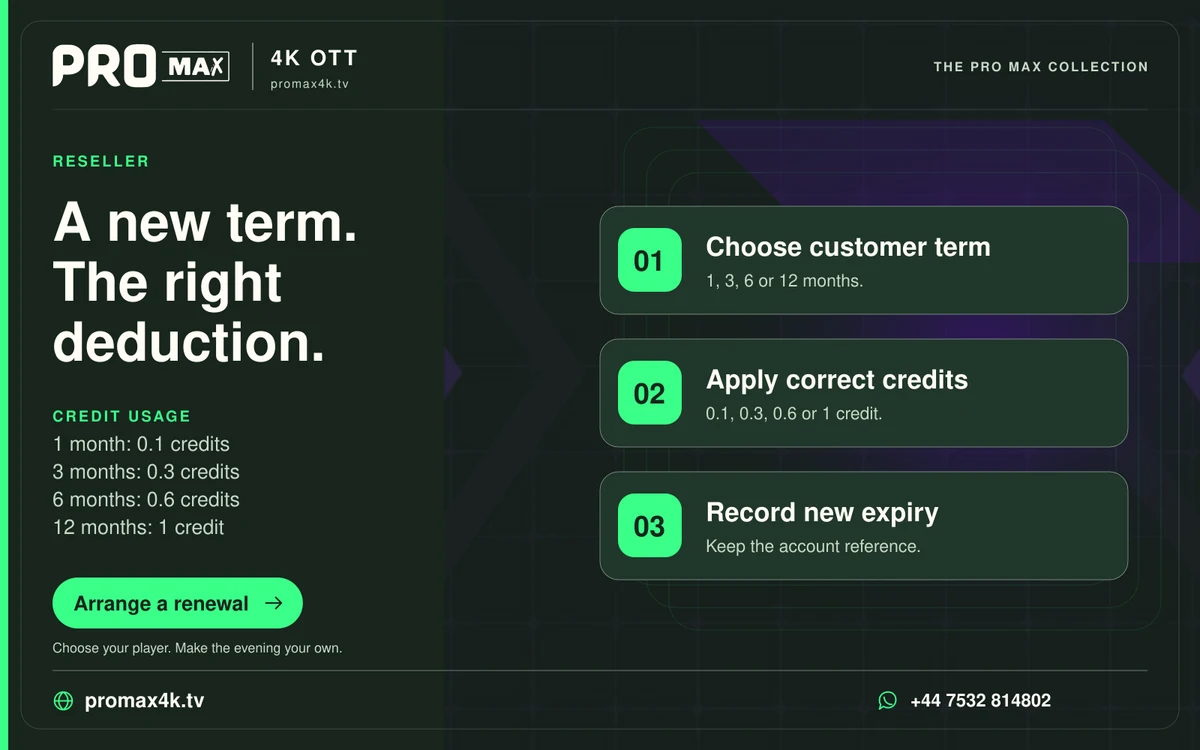
A rate of 0.5 credit per day should describe a known observation period or an explicit planning assumption. Write down which one it is. The figure should measure credit deductions, not customer counts: ten one-month allocations and one twelve-month allocation each total 1 credit under the published schedule, despite involving different numbers of accounts.
Calculate buffer and coverage separately
Fourteen days multiplied by 0.5 credit per day gives a 7-credit buffer. Divide the 28 free credits by 0.5 to get 56 days of coverage. The buffer is the amount you want to keep available for the chosen planning window. Coverage describes the current free balance at the same entered rate; it is not an expiry date.
Review the assumptions when the work changes
A burst of twelve-month orders can change credit use without a matching increase in daily customer count. Revisit the estimate when a large batch is confirmed or the daily pattern changes. Record panel adjustments separately. Package purchasing, credit expiry, processing times and business cash flow are additional considerations that this simple arithmetic does not establish.
A practical sequence
0 of 5 steps completed on this page.
An example to work through
At this snapshot, 28 free credits exceed the 7-credit buffer by 21. If the same 2 credits remain reserved, a displayed balance of 9 would leave 7 free. That is a planning threshold, not an automatic replenishment instruction.
Questions about this topic
Does 56 days mean the credits expire then?
No. It is a coverage estimate at 0.5 credit per day. Expiry rules must be confirmed separately.
What if usage is zero?
A days-of-coverage division is not meaningful at zero usage. Keep the balance visible and use another documented planning assumption.